
When most people start thinking about building a custom home, they naturally focus on what they’ll see every day—the finishes, the layout, the way each space will look once everything is complete. It’s the part of the process that feels tangible and exciting. You can picture it. You can react to it.
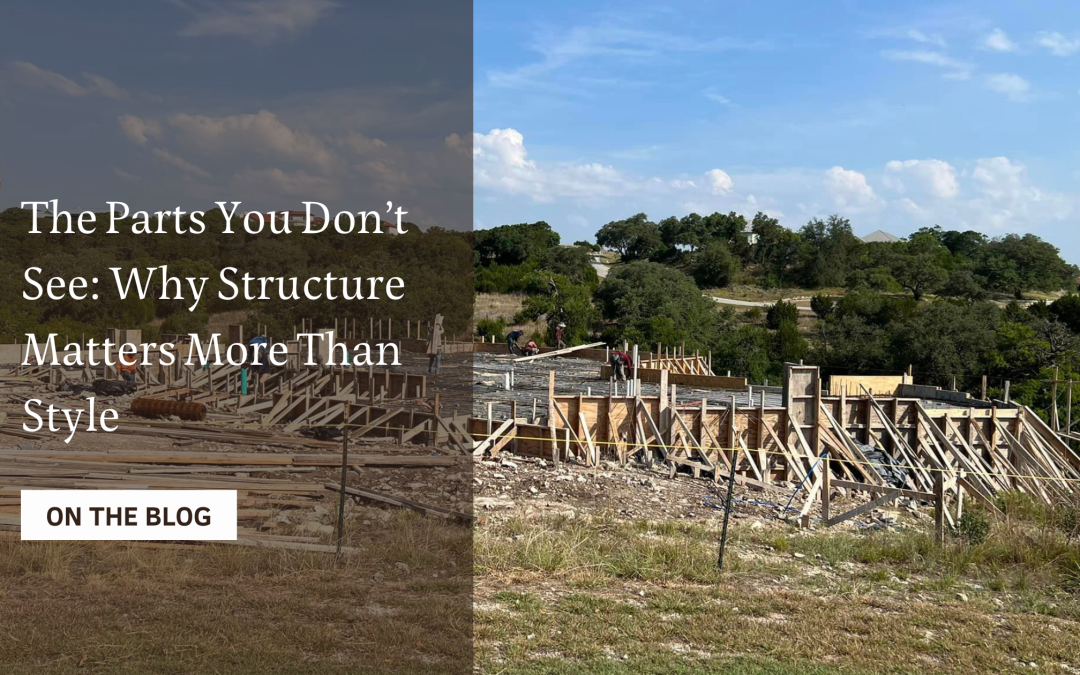
But long before any of those decisions come into play, there’s another layer of the home being worked out—one that doesn’t show up in photos or walkthroughs, yet has a lasting impact on how the home actually lives and functions over time. It’s the structural side of the build, and in many ways, it’s what defines whether everything else works the way it should.
It starts with the land
Every home begins with the lot, and in the Hill Country, that’s rarely a simple starting point. The land tends to come with movement—slopes, elevation changes, rock, and sometimes tight building areas that require careful planning from the very beginning. Add in the desire to capture a view, and suddenly the placement of the home becomes just as important as the design itself.
Before anything is drawn or framed, there’s a process of understanding how the house will sit on that land. Not just physically, but practically. Where does it step with the grade? What needs to be supported? How do you position the home so it works with the site instead of against it? Those decisions don’t just affect the foundation—they influence everything that follows.
Balancing what you want with what’s required
A lot of the work behind the scenes comes down to balancing design goals with structural realities. Homeowners often want open spaces, long sightlines, and rooms that aren’t broken up by columns or walls. They want large windows or glass walls that bring the outside in without interruption. And in a setting like the Hill Country, that makes perfect sense.
But achieving that kind of openness takes planning. A heavier roof system, like tile, changes how weight is distributed. Large spans require support that isn’t always obvious. Features like upper-level patios or balconies designed for entertaining bring additional load into the equation, especially when they’re expected to hold both people and furnishings comfortably.
Even something as specific as placing a hot tub on a balcony becomes a structural conversation. Once you factor in the weight of water and use, that decision affects how the entire area is supported—from the immediate framing all the way down through the home. These are the kinds of details that don’t stand out visually but are built into the experience of the space.
Making strength feel invisible
One of the goals in a well-built custom home is to allow the structure to do its job without becoming the focal point. When everything is working together the way it should, the structural elements fade into the background and the space simply feels right.
That openness in a living area, the clean line of a glass wall, or the way a balcony extends without feeling heavy—those moments are supported by decisions that were made much earlier in the process. Structural steel often plays a role in that, allowing for longer spans and fewer interruptions, but it’s not something that’s meant to be seen. It’s there to support the design, not compete with it.
When timing becomes part of the build
There are also situations where the order of construction matters just as much as the design itself. On certain lots, especially those with limited access or tighter spacing, you don’t always have the ability to build in a straightforward sequence.
In those cases, the project may need to start from the back of the property and work forward, with elements like retaining walls, terraces, or structural supports completed before the foundation is even in place. Other times, certain features need to be installed early simply because they won’t fit once the home is fully framed.
Those decisions are made well in advance, and they require coordination across every phase of the build. It’s not something that’s obvious from the outside, but it plays a significant role in how smoothly the project comes together.
The part that stays with the home
When everything is finished, most people won’t think about the structure behind their home—and that’s exactly how it should be. What they will notice is how the space feels. The way rooms open up without interruption, how everything seems to be in the right place, and the overall sense that the home is solid and well thought out.
Finishes can change over time. Styles evolve. But the structure of a home is permanent. It’s what supports every design decision and allows the home to function the way it was intended from the very beginning.
And while it may not be the part that gets the most attention, it’s the part that matters long after everything else is in place.